
TL;DR
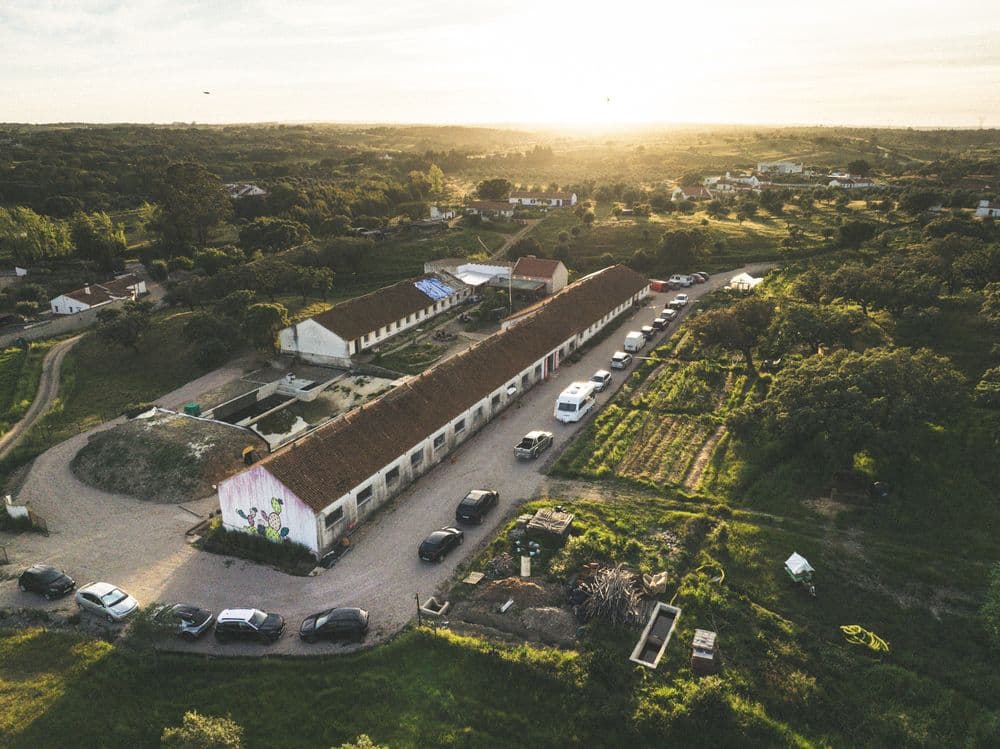
Five years in, Traditional Dream Factory is no longer a concept deck. It is a working regenerative ecovillage in Abela, Alentejo: 25 hectares, 4,000+ trees in the ground, 1.2 million litres of rainwater stored in 2025, a Mushroom Farm producing food and revenue, a Water Temple natural pool, and a community of 288 token holders co-owning the land via the $TDF token.
2025 was the year the prototype became infrastructure. 2026 is the year it becomes permanent.
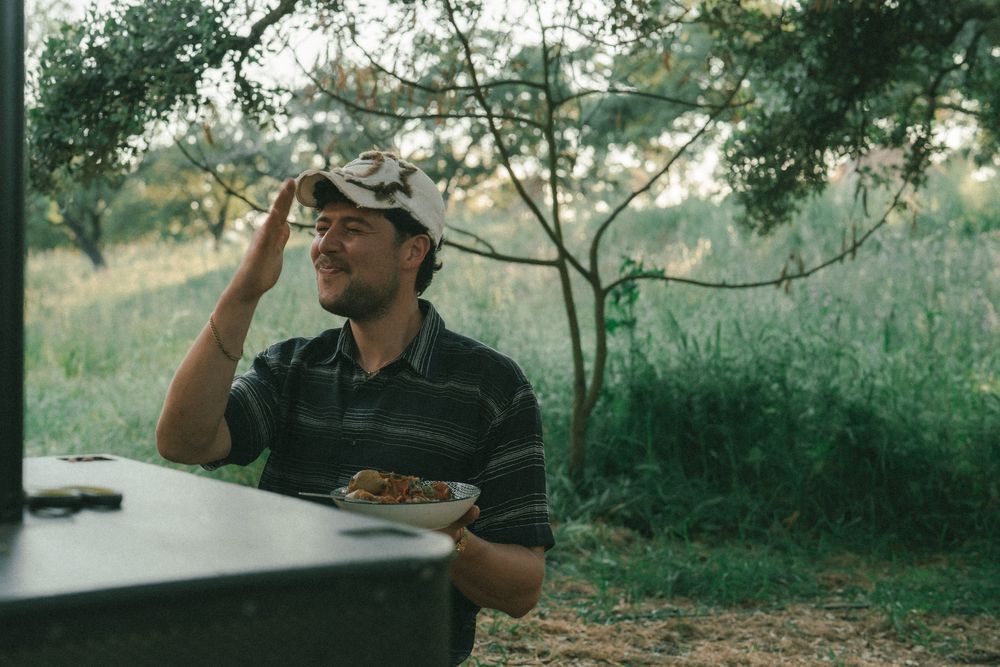
This spring alone we wrapped Harmonia 2026 (a four-day music and art gathering that lit up the new event hall), opened the gates for Nomad May, completed the first Co-Housing Pioneer cohort, and passed DIP-22 v2: a community-voted recalibration of the $TDF tokenomics designed to support the move into long-term residency.
Now we are mid-fundraise. The first €236k milestone exercises a 2023 land option on an asset expected to appraise at €1M. We are at €39k. The deadline is approaching. Fund the dream here.
Live token stats (as of May 8, 2026): 288 holders, 6,555 tokens in circulation, current price €262. Updates at the token page.
The view from May 2026
Spring came back to the Alentejo. The land is green and lush, the cork oaks are in full canopy, the food forest is propagating itself, and the social fabric on the ground is, as Michał put it in his April newsletter, high as ever.
For anyone searching for a regenerative ecovillage in Portugal, a coliving project in Alentejo, a DAO-governed community, or a tokenized land cooperative that has actually shipped, this is what one looks like at the start of its sixth year.
What follows is the long version: a feature read pulling from the 2025 End of Year Report, the State of TDF 2025 letter, the most recent on-the-ground updates, and the strategic moves the community has just made to take TDF into its village phase.
Part one: rewilding the land and feeding the future
The fastest way to understand what TDF actually is is to walk the land.
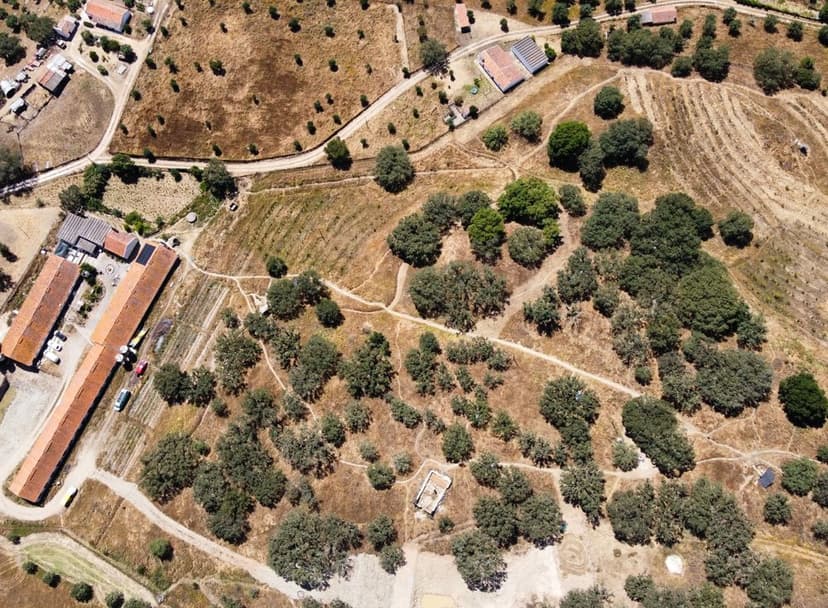
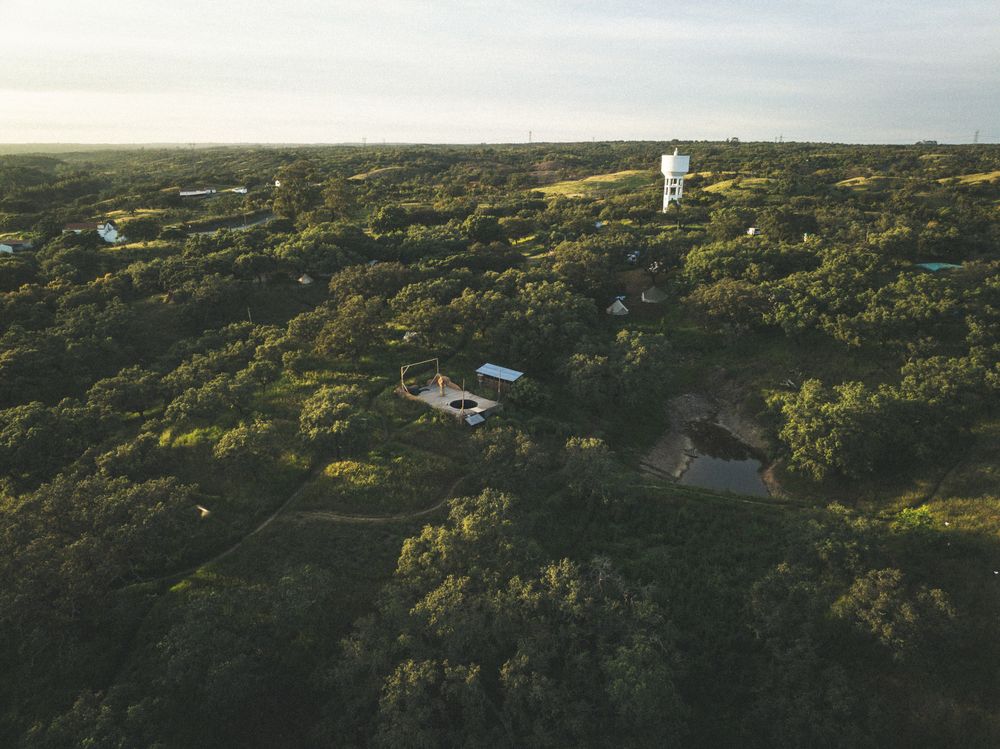
Five years ago this was a degraded hillside with an abandoned chicken-processing factory in the middle of it. Today it is a working regenerative landscape with measurable hydrology, measurable canopy, and measurable food output.
In 2025 we put down a new jungle hedge: 333 native trees and shrubs along the boundary, planted as a living windbreak and a fire buffer. Combined with the existing food forest and reforestation zones, the digital tracking via Open Forest Protocol now covers about a hectare in detail, and the cumulative tree count on the land sits at 4,000+.
The bigger story is water. After years of experimenting with swales, ponds, and infiltration trenches, 2025 was the year of planting the rain in earnest. We added a 50,000-litre storage tank, expanded swales, turned the old chinampa into a pond, ran new greywater-fed irrigation zones, and built a pump system for the bio-pool. Across the rainy months we stored over 1.2 million litres of rainwater on the land, which we drew down through the dry summer.
On the soil and food side, the loops kept tightening. Resident builder Evya Tar raised a propagation greenhouse in a single day, and our seedling capacity went from a few trays to thousands of plants. The Garden team ran new syntropic veggie lines through the food forest. Building resident Kiko built a new chicken-compost factory designed by Mica, and our flock now spends its days turning kitchen scraps into compost while living inside Cluckingham Palace, the upgraded coop that even has a disco ball. Egg production is up to about a dozen a day. The humanure system was rebuilt so that nothing leaves the land that the land cannot use.
And the Mushroom Farm, spearheaded by steward Tonya, went from blueprint to functioning facility inside two converted shipping containers. By December it was producing oyster and shiitake mushrooms for the kitchen and for sale, and Richard's first fungi course had run there as a paying workshop.
The full ecology picture is at traditionaldreamfactory.com/pages/ecology.
Part two: the build
The build team doubled in 2025. Tias and Julia joined Luca, Marco, Kiko, Evya Tar, Idalio, Kirsty, Max, and Sebastian, plus a rotating crew of volunteers. By December the completed-projects list included:
- Nursery Café & Lounge with custom furniture by Kiko, skylight roof by Tias and Ron, art by Kinga, and plants by Dylan
- Water Temple natural pool, finished just in time for Água Será in June
- Mushroom Farm in two converted containers
- Events space with new flooring, windows, doors, and fireplace
- Restaurant bar, debut home of Cafe OVO by Kinga and Roxy, with the bar itself built by Julia and intern Tara
- New compost toilets, hot showers, and wash stations across the site
- Cluckingham Palace chicken coop
- Pergola, French drains, propagation greenhouse
- Team house renovation with microcement floors, new staircase, loft, and finished windows
Around 10 volunteers and one intern were trained in basic carpentry alongside the work. The principle is simple: the village teaches the village.
Part three: people, kitchen, and culture
Across the year, 54 volunteers and 30 residents passed through TDF under the structured 2-week and 1-month volunteer program. Long-term residents and a growing circle of citizens kept the daily rhythm.
The kitchen converted to roughly 95% local sourcing. Vegetables come from neighbouring farms within a 30km radius, honey and olive oil from villagers in Abela, even the rice from Melides. Dry goods arrive in bulk with zero packaging. The locals love the food. So do we.
Weekly sharing circles, women's circles, transparency circles, feedback sessions, and forums kept the social fabric tight. The second cohort of the Stewardship Educational Program ran for 12 weeks in the spring, training Tonya (Mushroom Farm), Timur (Garden), and Kinga (Garden and chicken care). Each produced a real artefact: the mushroom-farm research launch, a comprehensive chicken care guide, and full garden care protocols.
And in September we welcomed Nilai Adam Jansen Franco, TDF's first baby. A multigenerational village stopped being aspirational the moment he arrived.
Part four: the platform layer
TDF runs on Closer, the open-source community-management stack we have been building under OASA's stewardship. In 2025 the platform shipped:
- Automatic revenue recognition tied to the booking flow
- Expense-tracking automation
- A dedicated Governance page with on-chain anchored proposals
- A revamped Citizenship onboarding with a vouching process for new applicants
- Financed token sales (so people can spread payment over time)
- Role-based access control
- An upgraded affiliate dashboard
The booking engine itself processed 4,867 nights across 396 bookings from 1,016 new accounts over the year, a +101% jump year on year.
On the comms side, White Rabbit PR delivered 140 press articles, including a full-page Económico feature on TDF as a tech-anchored regenerative village in the Alentejo. The website pulled 32k visitors, and Instagram added 1,047 followers (+9%).
Part five: 2025 by the numbers
The financial picture is clean and conservative.
Revenue (operations) €83k
Expenses (operations) €86k
Token sales raised €106k (€77k bank, €32k crypto)
New debt raised €50k
Debt repaid (as tokens) €19k
Renovations capex €130k
Mushroom Farm capex €17k
Cash on hand at year-end €172k
Outstanding debt €402,384
Token holders at year-end 280
A revenue-neutral operating year, with all the heavy capital deployed into infrastructure that now generates licensed-hospitality, restaurant, and Mushroom Farm income going forward.
Part six: events and the rhythm of the year
In 2025 we hosted 14 events with 358 attendees: Burn The Sheep, Harmonia, Common Matters, the ReFi Garden, Forest Rave showcase, Água Será, Boom Decompression, the September Pop-Up Village, the Citizens' Gathering, NOOR with the Kosmic Kamels collective from Palestine, Israel, and SWANA nations, Ignition Point, Abela Art Faire, the Mycelia Intensive, and the Christmas Mercado Comunitário in Abela.
The pivot through the year was deliberate: international festival energy in spring and summer, deep local integration with Abela in autumn.
Harmonia 2026: the spring opener
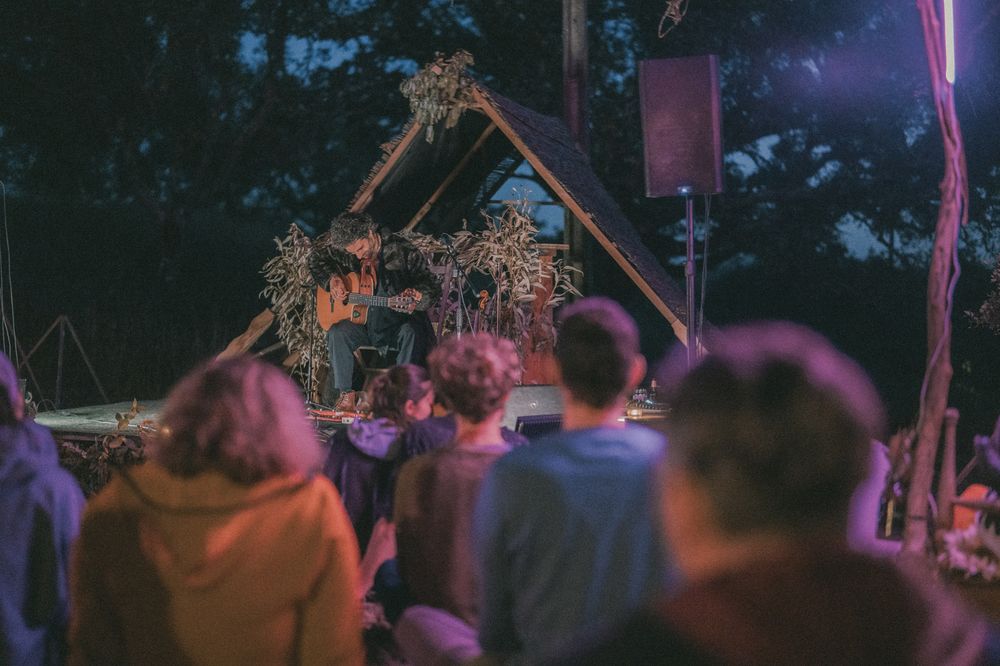
Harmonia 2026 ran April 16 to 19, and it was the gathering that christened the upgraded event hall. Four days of curated music, workshops, art installations, wilderness sessions, and ceremonial handpoke tattoos.
Highlights: Edgar's Portuguese folk-song journey, Hugo's body-movement workshop, Josh and Mel's multi-sensory wilderness session via Kambium, Michał's interactive card installation, multi-instrumental sets by Avi and Shai, and ceremonial handpoke tattoos by Talyssa.
Nomad May: happening right now
Nomad May is open right now, May 1 to 31. A full month of living and working from one of Europe's most active regenerative communities, hosted by Luna. Accommodations range from glamping to private rooms, €320 to €1,130 for the full month. Slots are still available; bookings require space-host approval.
If you have ever wanted a longer-form taste of village life before committing, this is the on-ramp.
Land Tour, May 7
The monthly Land Tour and Open Afternoon ran on May 7. The next one will be announced on the events page. Open gates, a guided walk through the land, and a chance to ask anything.
UNLEASHED, May 29 to 31
End of May brings UNLEASHED, Stories in Motion, a community-based artistic project bringing together women from different life contexts to explore experiences of freedom and non-freedom through body, voice, and words.
Part seven: governance, just shipped
In April, the community voted on DIP-22 v2: Revision of $TDF Token Supply & Distribution Model, authored by Ani Anca after months of work in the tokenomics working group. The proposal addresses the structural shift TDF is undergoing: from being a coliving and event venue, to becoming a hybrid village with long-term co-housing residents alongside rotational hospitality.
In short, the original 18,600-token cap was modelled on year-long accommodation across all units, including land-based units that turned out to require a camping licence incompatible with our development plan. DIP-22 v2 corrects this with a more honest model.
What changed:
- A clean stay-discount ladder. 30% off after 7 days, 50% off after 30 days, 70% off for stays of 90 to 365 days (the deepest tier reserved for studios under DIP-23, the long-term staking model).
- Full-site privatization at a fixed cost of 50 tokens per night, reservable up to 12 months in advance. This opens the door for aligned organisations, retreats, weddings, and gatherings to lock the whole site through tokens.
- Co-housing parity. Tiny-house and townhouse residents will stake 383 to 820 tokens depending on unit type, with a minimum 3-month annual presence and the option to rent the home through TDF for the rest of the year, sharing revenue.
- A revised supply cap of 15,097.50 tokens, of which 6,485 are already sold, 3,774 are kept in hospitality reserve to protect guest revenue, and 4,838 remain available for public sale, roughly 150 citizenships. Those tokens are explicitly earmarked to finance the coliving build.
The headline: $TDF is now coherent across coliving, co-housing, and hospitality. Long stays are rewarded. Short stays still work. And for the first time, the token supports full-site privatization and long-term residency in the same instrument.
Read the full governance archive for the rest of the active and recently-passed proposals.
Part eight: co-housing, now opening
This is the news many of you have been waiting for.
The first Co-Housing Pioneer Program wrapped this spring. We ran it small and slow on purpose: a real cohort of prospective residents who walked through the legal, financial, and lifestyle implications of becoming co-housing members. The lessons from that round are now baked into the program, and applications are opening for the next cohort.
The full co-housing pages lay it out, but the shape of the offer:
Two neighbourhoods. 23 homes.
Earthpods. 10 compact, beautifully-designed homes, 50 to 90 m², nestled inside the 7-hectare food forest. From 365 $TDF locked. Designed for individuals and couples who want to live light on the land, walking distance to the village centre, with privacy and forest immersion.
Townhouses. 13 multi-bedroom family homes, 144 m², in the quieter section of the village, each with a private garden. From 750 $TDF locked. Designed for families and growing households.
What you get with the home
You join a village ecosystem, not just a house. Resident-rate access to the licensed farm-to-table restaurant. Chemical-free natural bio-pool. Community sauna and wellness spaces. Starlink-backed coworking. A makerspace with 3D printers, workshop, and industrial-kitchen access. And a vote in the OASA-stewarded DAO that governs the village.
The honest part
We do not sell paradise. Community is hard. There are conflicts, setbacks, and days when the vision feels far away. What we offer is a real experiment with real people on real land, five years deep into the work, with a commitment to transparency and to staying in relationship even when it is uncomfortable.
The path forward
- 2020: Land option secured
- September 2025: PIP submitted
- January 2026: PIP response received
- April 2026: Land closing in motion
- 2026: Infrastructure, lakes, roads
- 2027: First homes completed
If this resonates, join the co-housing waitlist and we will reach out as the next cohort opens.
Part nine: the $TDF token, today
$TDF is the access layer for the entire village.
One $TDF = one night of stay per year, every year, for life (subject to availability and accommodation type), plus one vote in the DAO. 30 tokens qualify for citizenship, 383 to 820 tokens for co-housing under DIP-22 v2.
Live, as of today (May 8, 2026)
Token holders 288
Current supply 6,555
Current price €262
Max supply (per DIP-22 v2 cap) 15,097.50
Tokens reserved for public sale ~4,838 (≈ 150 citizenships)
Token contract Celoscan
Holder distribution Holder chart
Live numbers update at the token page and via the public stats endpoint. The bonding curve means the price ticks up a little with every token sold, so the cheapest day to buy is always today.
For the full architecture, including $Presence (proof-of-presence governance) and $Sweat (labor governance), the OASA Whitepaper V1.2 goes deep. Impact investors should head straight to the data room.
Part ten: the road ahead. Final steps to a licensed hospitality village.
After five years of proving the impact, the community, and the operating model, we know exactly what is missing. It is not vision. It is permitting, infrastructure, and capital.
The TDF fundraiser breaks the path to licensed hospitality into four staged milestones, each closing a critical legal or operational requirement.
CURRENT — €236k. Buildings option exercise, architecture, and engineering fees
We hold a secured option to buy, signed in 2023 at €200k, on a building asset now expected to appraise at €1M. Exercising it locks in the core land of the masterplan and unlocks architecture and engineering fees for the next phases.
€39k of €236k raised. Deadline approaching. Every backer counts.
NEXT — €150k. Solar roofs and pool completion
Solar prices are rising. Through Kinterra we have a special deal to buy panels at cost, and we are stacking functionality by turning the panels into a waterproofing layer over our roofs, killing two problems with one budget. Once installed we expect €600+ per month in energy income as we anchor the Abela microgrid. Plus the long-overdue completion of the bio-pool.
FUTURE — €150k. Industrial kitchen, 30-seat licensed restaurant, and 4 creative studios
This milestone unlocks our legal restaurant with 30 seats, a core revenue driver, alongside four naturally-lit studios for artists-in-residence and workshops. We expect bank or grant co-financing on this step. More on the food vision at the restaurant page.
FUTURE — €150k. Co-living building (community co-budget on a €750k total build)
The 12 en-suite rooms, dorms, and 3-bedroom house that bring TDF to full licensed coliving capacity. This is the community co-budget on a €750k total build, with the remainder targeted via bank or grants.
Why this matters
What is being built at TDF is not a niche experiment. Syntropic agroforestry. Tokenized land stewardship under a Swiss-Verein non-profit (OASA) with a Portuguese operating company. DAO governance with on-chain proposals. Regenerative hospitality. Microgrid energy. Multigenerational community. Open-source platform infrastructure (Closer) replicable for any community that wants to follow.
It is a working prototype of what villages can become in the second half of this century. 2025 proved the prototype operates. 2026 makes it permanent.
The dream is no longer a dream. It is a building site, a balance sheet, a baby, a Mushroom Farm, a working DAO, and 288 people who already own a piece of it.
Come help finish it.
How to plug in
Whether your time horizon is a weekend or a decade, there is a way in.
- Visit. Book a stay or come to the next Land Tour. Nothing replaces walking the land.
- Stay a month. Nomad May is open right now.
- Volunteer. Two-week and one-month structured programs.
- Get $TDF tokens. Buy here. Lifetime stay rights, governance vote, and a citizenship path at 30 tokens.
- Join the co-housing waitlist. Earthpods or Townhouses.
- Back the fundraiser. The €236k current milestone is live.
- Invest as an impact fund. Data room here.
With love from the TDF Team in Abela. Baaaaah. 🐑
Special thanks to Axel Massin for many of the photographs. Read the prior letters: State of TDF 2025 and Spring is Blooming in the Dreamland.